
A stackable outdoor restaurant chair is useful only if staff can stack, move, and store it safely in the available space. Check the permitted stack quantity, full stack dimensions, individual weight, contact protection, and trolley compatibility. The footprint of one chair does not describe the footprint of a loaded stack.
Start with the closing routine. Count the chairs that must leave the patio, identify the storage location, and walk the route between them. A small storage room, tight turn, threshold, or staircase can make a seemingly compact chair impractical after every service.
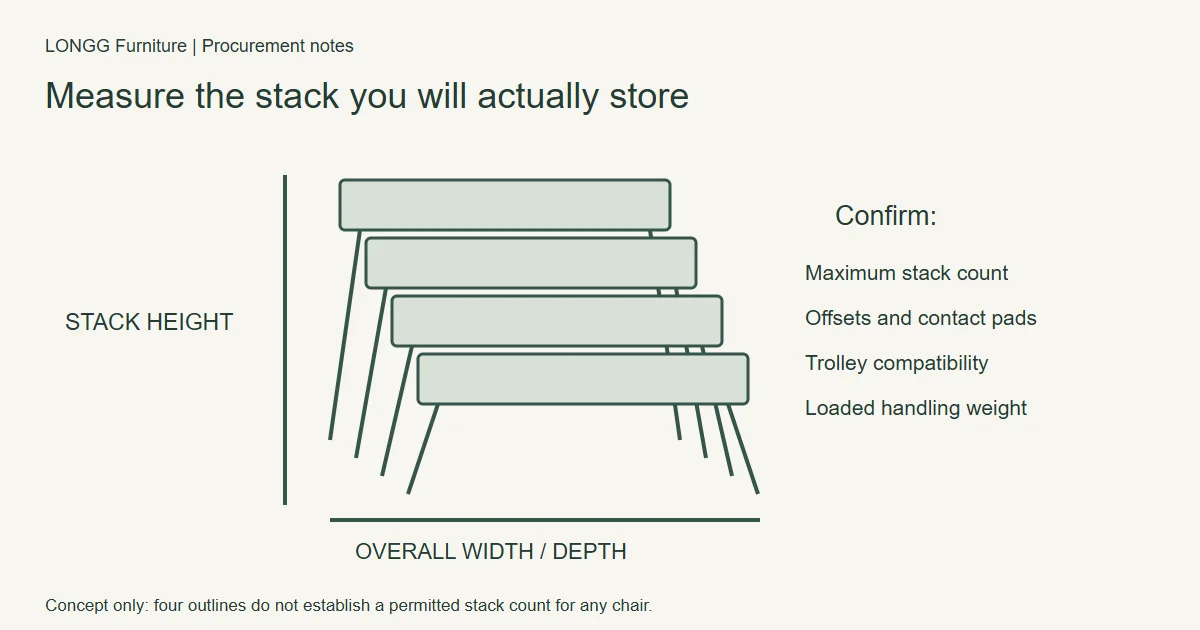
Ask for a stack drawing, not just the word “stackable”
The drawing should show the maximum recommended quantity, overall width, depth, height, and any backward lean or horizontal offset. Ask whether the limit applies to static storage, movement on a trolley, or both. Those uses may have different conditions.
Manufacturer data demonstrates why the model matters. Nardi's Net collection data sheet lists weight and stacking information for its specific products. Those figures should not be applied to another chair that looks similar. Request equivalent information for the exact configuration being quoted.
Armrests, wider seats, cushions, and frame changes can alter stacking. If your chosen model differs from the sample in the stacking demonstration, ask for confirmation of the revised version. A chair should not be described as stackable merely because it balances on another chair.
Calculate the storage area from complete stacks
Use the approved chairs-per-stack quantity to calculate how many stacks you need, rounding up. Then use the measured stack envelope, not the single-chair dimensions. Add space for access, handling, trolley placement, and the storage room's door swing.
For illustration only, 24 chairs stored in four approved stacks of six would need four stack positions. If each hypothetical stack envelope were 0.60 by 0.80 meters, the four envelopes alone would total 1.92 square meters. That calculation excludes aisles and handling space and is not a recommendation for any chair model.
Draw those rectangles at scale in the actual room. Check whether the last stack can be placed and retrieved without first moving all the others. Keep access routes clear. A mathematically sufficient floor area can still be unusable when the door and columns are included.
| Measurement | Why it matters | How to verify |
|---|---|---|
| Loaded stack envelope | Controls storage positions and door clearance. | Measure the approved stack. |
| Trolley with chairs loaded | May exceed the static stack dimensions. | Check the complete moving assembly. |
| Lowest route clearance | Can limit stack height or handling method. | Walk the full route, including turns. |
| Retrieval space | Allows staff to remove chairs without awkward lifting. | Rehearse the first and last stack movements. |
Weight accumulates faster than expected
Ask for the actual finished chair weight, including any attached seat pad. Multiply it by the approved moving quantity and include the trolley where relevant. Total weight alone does not determine a safe handling method: grip, balance, reach, route, and staff capability also matter.
For another arithmetic example, six hypothetical 4-kilogram chairs weigh 24 kilograms before adding equipment. This is not a suggested manual lifting load. Use the manufacturer's handling instructions and your site's handling assessment to decide how the chairs should move.
A lighter chair may simplify movement but still needs an appropriate outdoor design and weather procedure. Do not use stacking as an improvised response to wind. Follow the venue's weather plan and the manufacturer's storage guidance.
Inspect the contact points between chairs
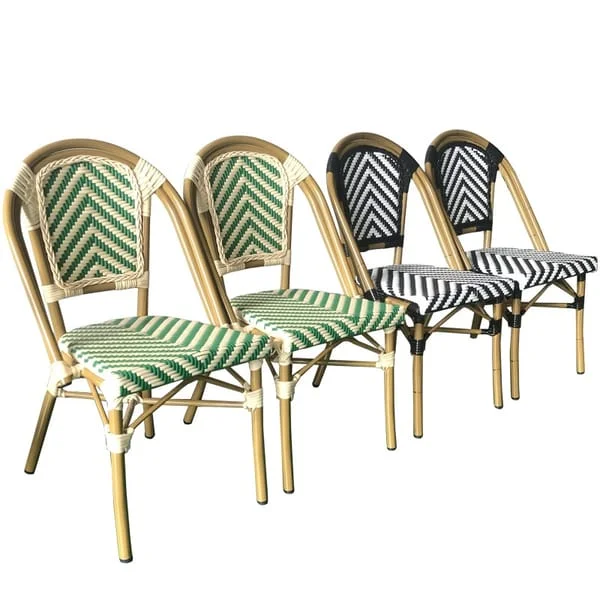
Watch a stacking demonstration slowly. Identify where each chair bears on the one beneath it. Ask whether protective pads, bumpers, or spacers are fitted and whether they can be replaced. Hard contact on a decorative coating can cause visible damage during repeated handling.
Check whether woven parts, upholstery, arms, or seat edges carry pressure that the design did not intend. Chairs should separate without forcing or dragging surfaces together. If staff need to twist the stack apart, ask the supplier to demonstrate the correct method and explain any limits.
Look for grit at the contact points after patio use. Cleaning and drying before storage can prevent debris being trapped between surfaces. Use the selected product's care instructions; do not assume that pressure washing is suitable for the frame, weave, coating, or attached cushion.
Rehearse one complete closing cycle
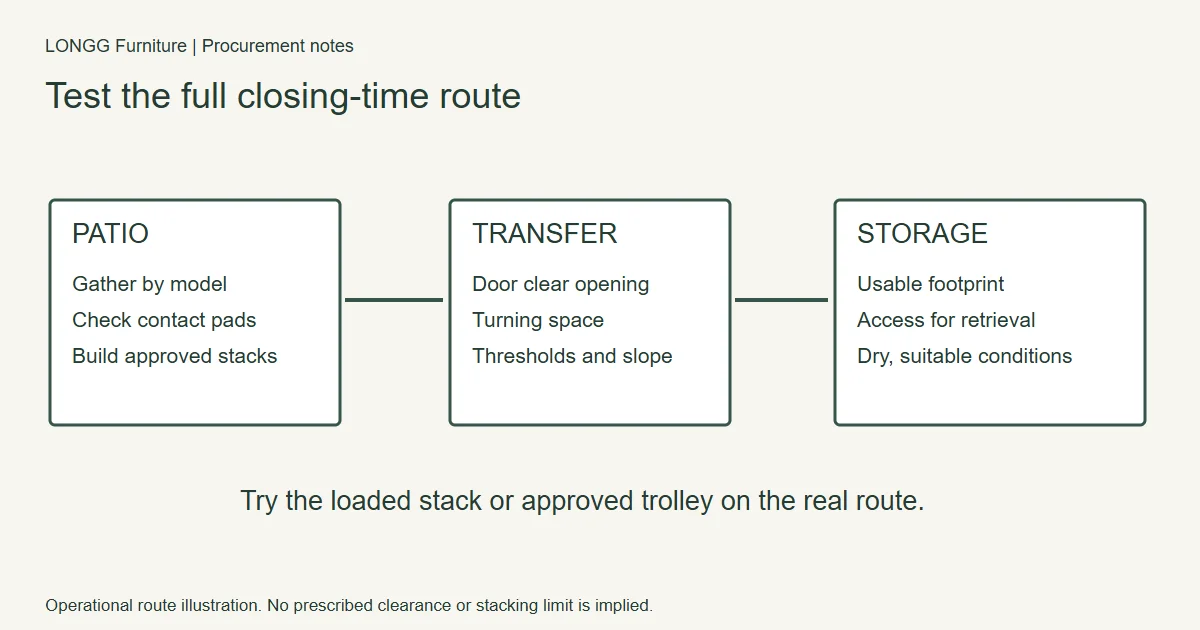
Bring the sample chairs and any proposed trolley to the venue where practical. Clear the table, clean the chairs, stack them, move them to storage, and retrieve them again. Record the steps that require a second person or additional space.
Include the awkward parts of the route: door closers, ramps, lift entrances, uneven paving, and the transition from outdoor to indoor flooring. Confirm where the trolley can wait without obstructing circulation. A trolley designed for a different chair is not automatically compatible.
Review outdoor furniture options with this operating sequence. For broad material and exposure choices, use the existing outdoor furniture buying guide; this checklist is specifically about stacking and storage.
Seasonal storage needs a separate plan
Daily closing and winter storage are not necessarily the same arrangement. Long-term storage may require additional cleaning, complete drying, cushion removal, ventilation, and protection from accidental impact. Ask whether covers are appropriate and how to avoid trapping moisture.
Label stacks by model and condition. Separate chairs awaiting inspection or repair so they are not returned to service during a rushed setup. Keep replacement glides and stacking protectors identified by the relevant chair code.
If patio furniture is shared with events, coordinate storage with the event furniture handling plan. Different models can look compatible but should not be mixed in a stack unless specifically approved.
Does “stackable” mean cushions can stay attached?
No. Ask whether the approved stack includes the selected cushions and how their fasteners or covers are protected. If cushions must be removed, include their separate storage space and drying routine in the closing plan.
When requesting options from LONGG Furniture, send the patio chair count and storage measurements, route photographs, exposure conditions, and any trolley requirement. Request a model-specific stack drawing and demonstration before approving the order.